Segmental post-tensioned hollow-ceramic columns — topology-optimized and robotically machined — paired with a kinematic folding canopy simulated as a digital twin. Co-authored with Prof. Juan José Castellón and published at the IASS 2024 Symposium.
Co-authored research at IASS 2024 — I worked on this as a computational research assistant at Rice University (2021–2024), collaborating with Professor Juan José Castellón. The work was published at the IASS 2024 Symposium as Castellón & Chen, Segmental Ceramic Hollow Structures: Prefabricated post-tensioned columns for ecological urban infrastructures — I am the second author. My contribution was on the computational side: the topology-optimization pipeline that generated the column catalogue, the robotic-toolpath and fabrication simulation, and the Kangaroo form-finding / digital-twin of the kinematic canopy.
What it is
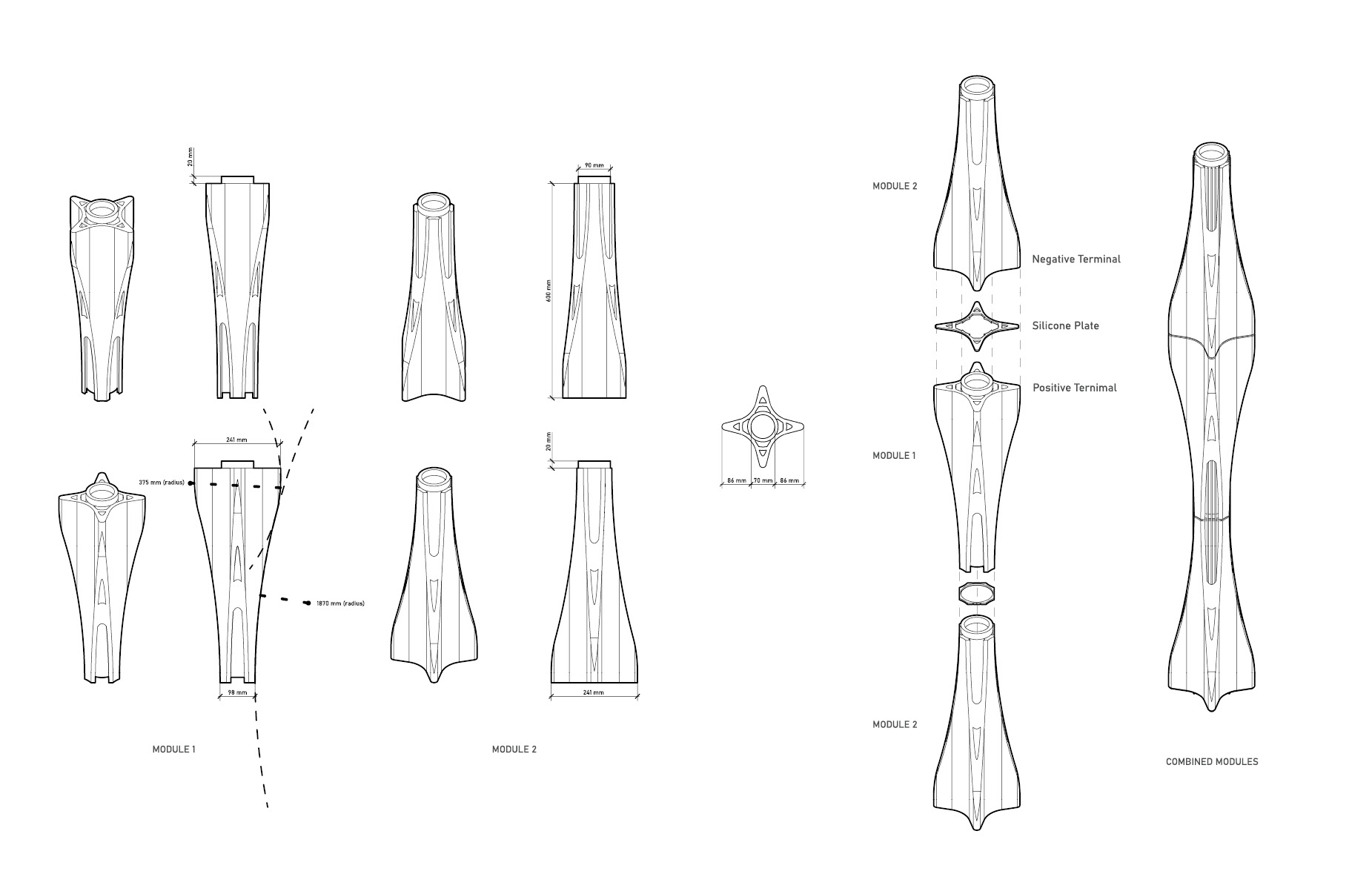
The research develops hollow building components that combine structural and ecological functions — a load-bearing column that is simultaneously a rainwater collector, with aspects of climatic control and water storage built into the same hollow ceramic body. The structural system is a segmental post-tensioned column composed of hollow ceramic components: individually manufactured segments are stacked and drawn together by a post-tensioning tendon into a single monolithic column.
The design language borrows from a specific precedent. In the 1960s, Spanish architect Miguel Fisac and engineer Ricardo Barredo developed post-tensioned hollow concrete beams; this project carries that idea into ceramic and into the age of robotic fabrication. The material distribution itself is bio-analogous — inspired by how bone places mass along load paths and hollows out where material is redundant.
The problem
Solid masonry and concrete columns are structurally wasteful: most of the section carries little load, yet it is expensive to make, heavy to ship, and does nothing beyond standing up. The research asks whether a column can be (1) material-efficient — hollowed exactly where it can afford to be, (2) prefabricated and modular — made from repeatable segments rather than cast monoliths, and (3) multi-functional — earning its footprint by also collecting and storing water and moderating microclimate. Meeting all three at once is what makes it a fabrication problem as much as a design problem: the optimized geometry has to be something a workshop can actually produce.
System overview
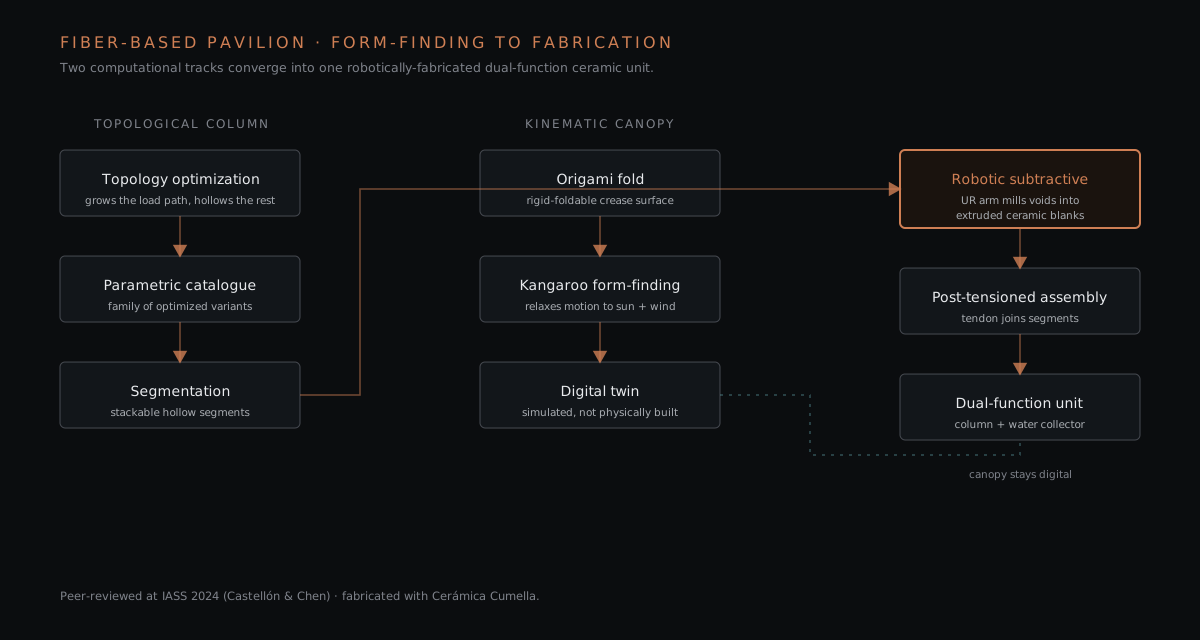
The two halves of the pavilion — the compression member and the shading surface — are developed on parallel computational tracks, then resolved together at the column capital. The column track ends in physical fabrication; the canopy track is delivered as a digital twin.
Topological column form-finding
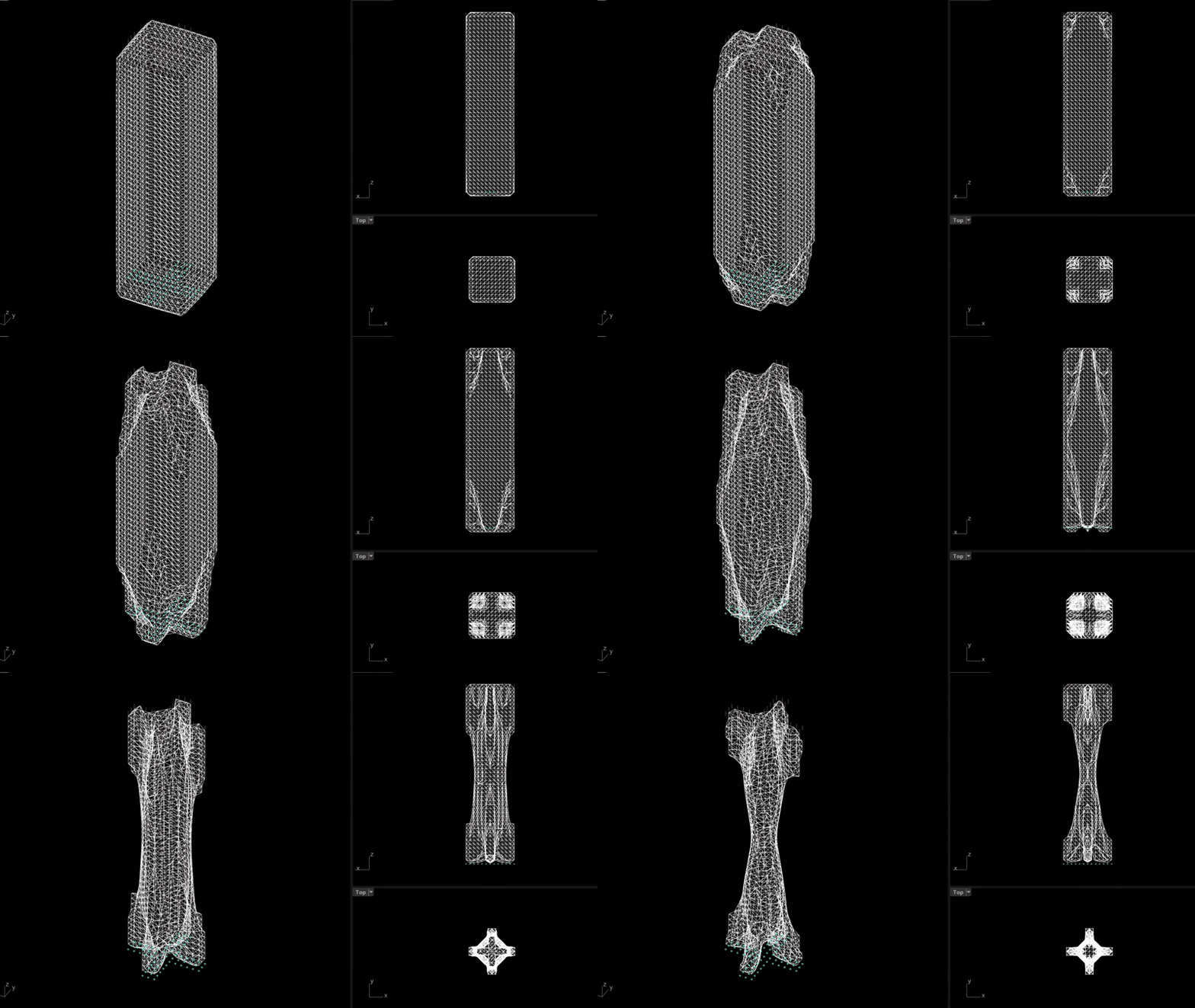
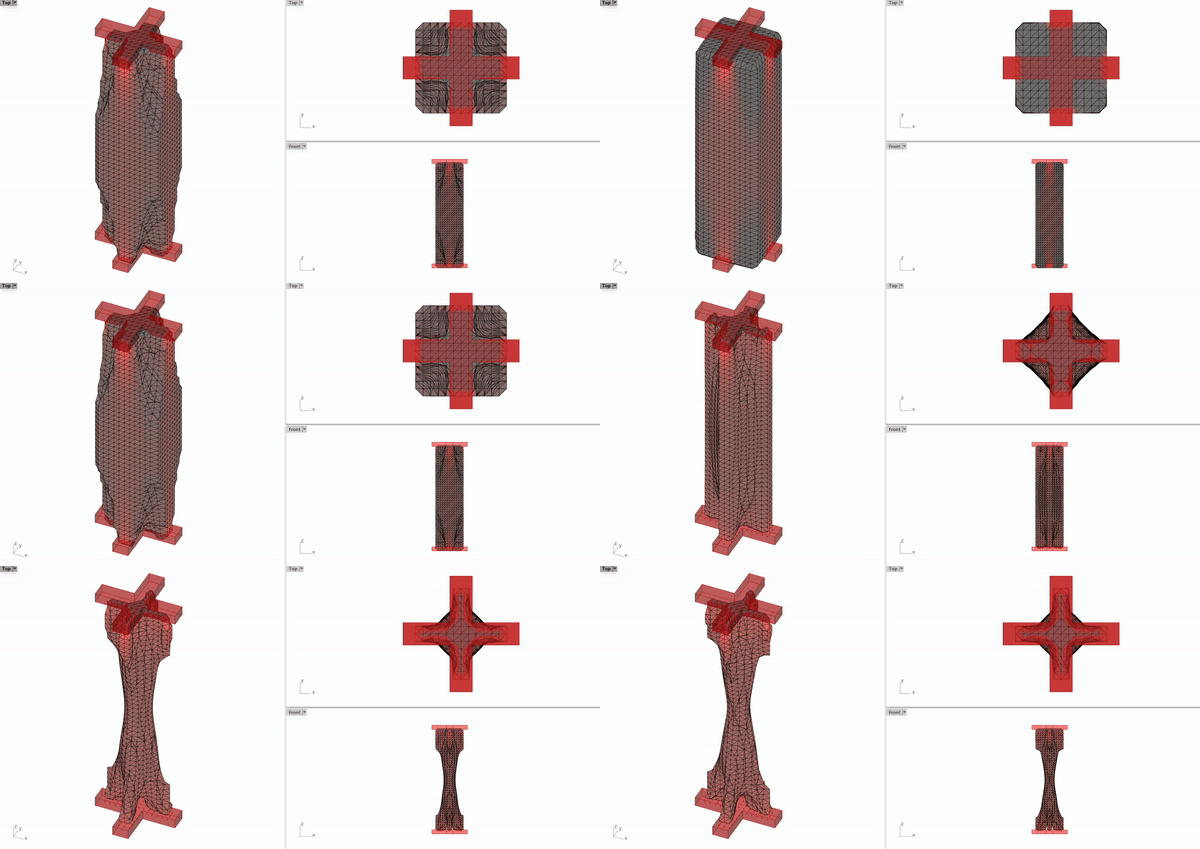
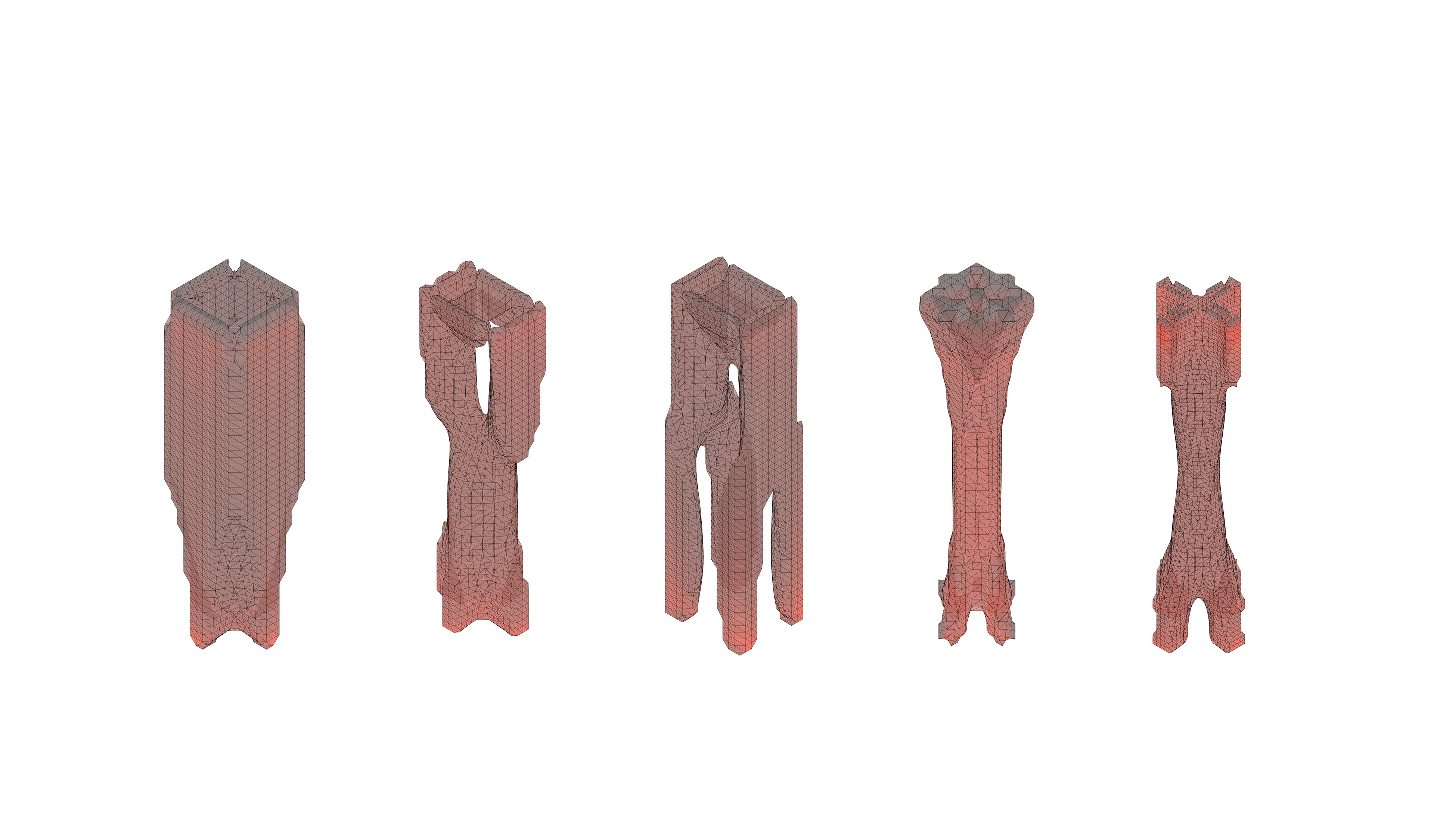
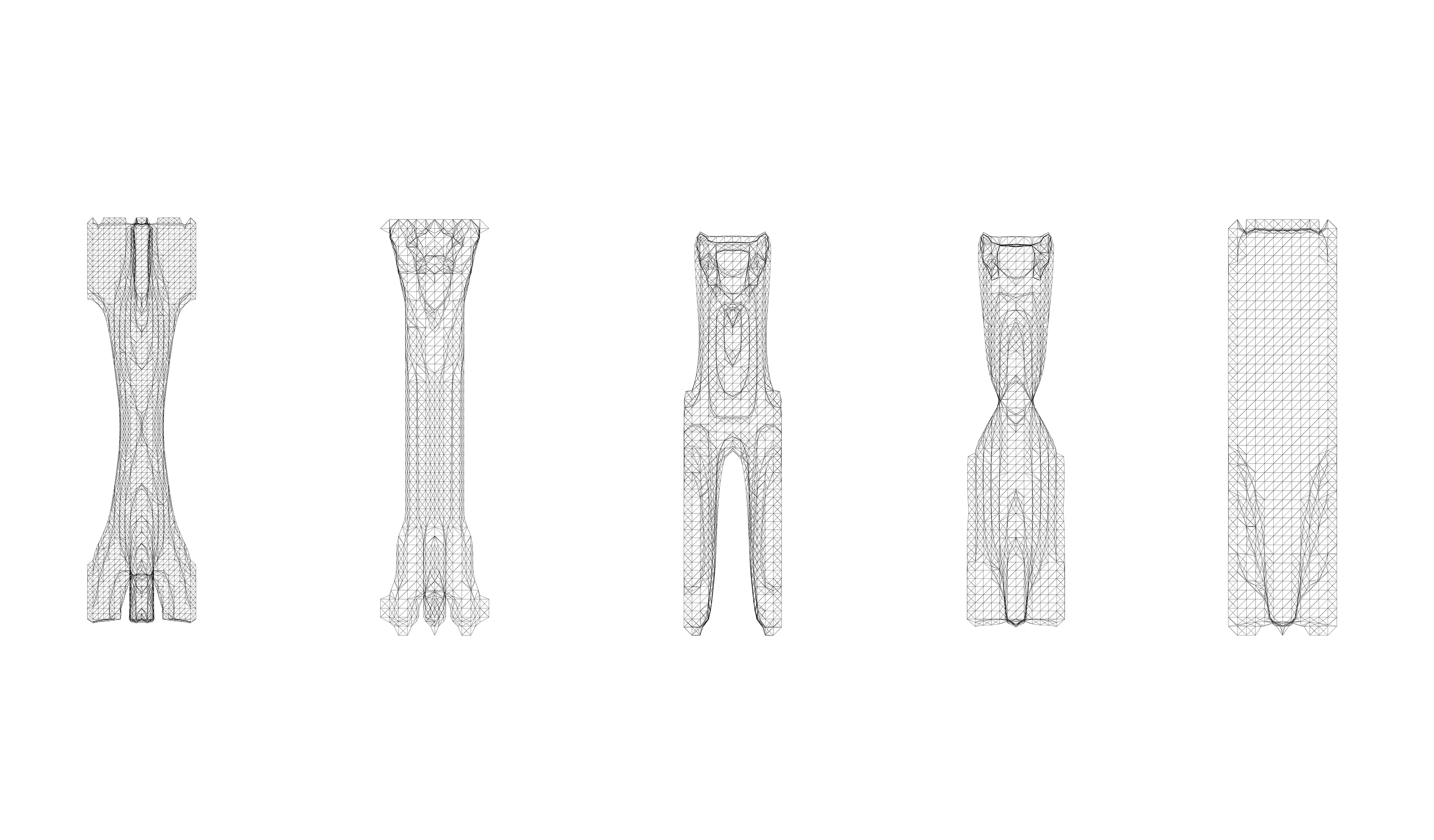
The column geometry is not drawn — it is grown by topology optimization. Starting from a solid rectangular blank meshed for finite-element analysis, the optimizer iteratively resolves the compression load path and removes material where it contributes little, keeping mass where forces concentrate. Over successive iterations the plain prism evolves into a hollow hourglass profile with longitudinal void slots — the visible read of the underlying stress field.
The FE-meshed iteration steps below show that evolution directly: a solid block, triangulated, with the red stress-density field intensifying along the retained load paths as the section is progressively hollowed toward a bone-like distribution.
Ceramic column design catalogue
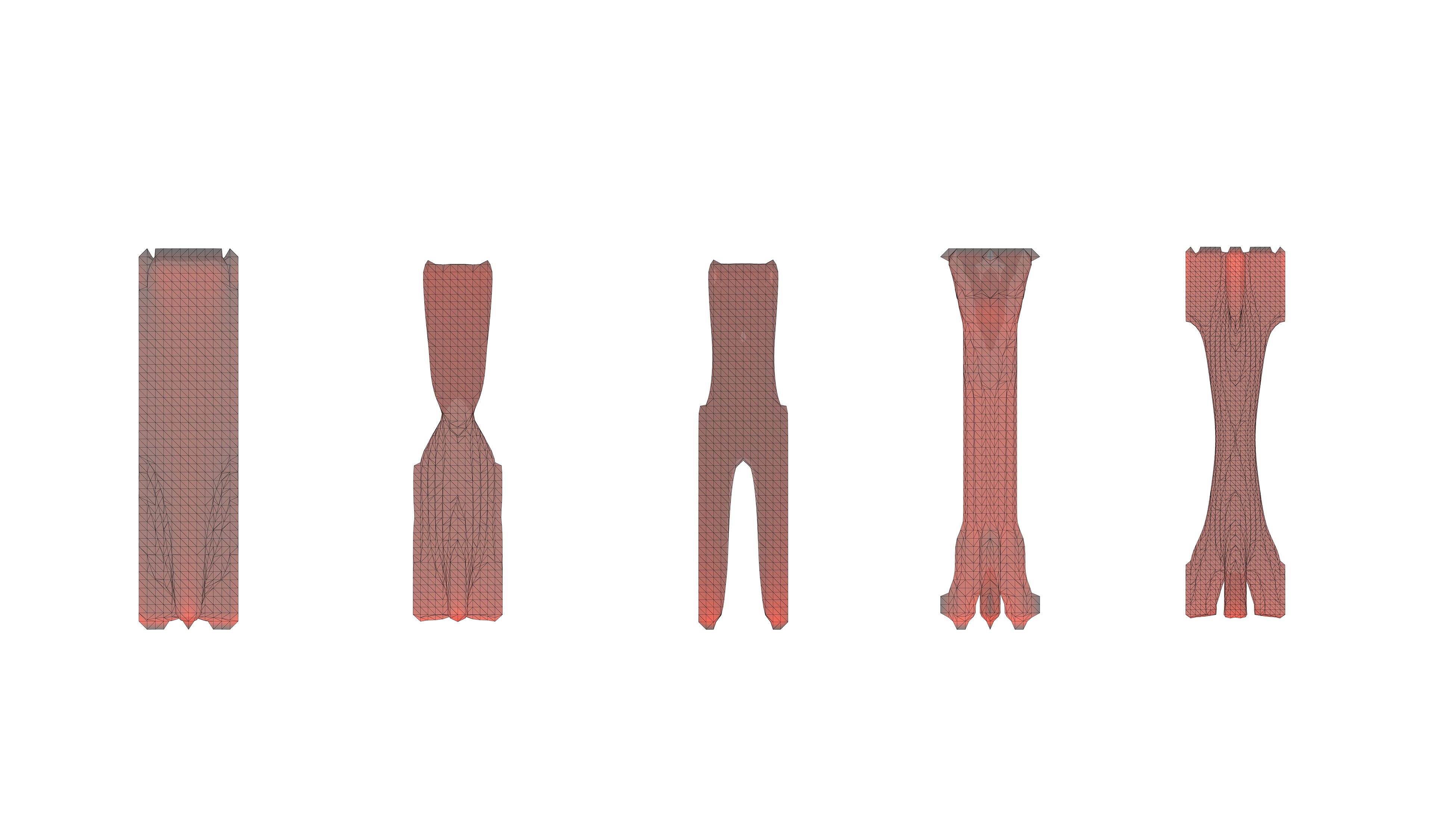
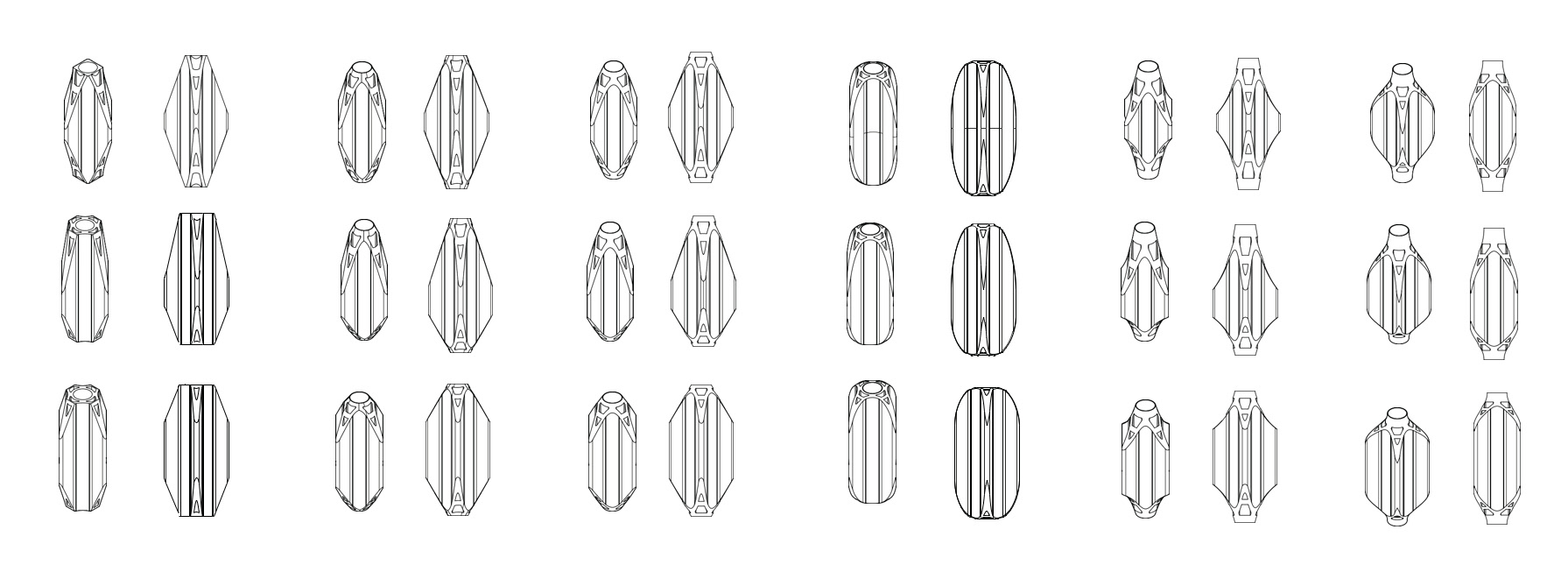
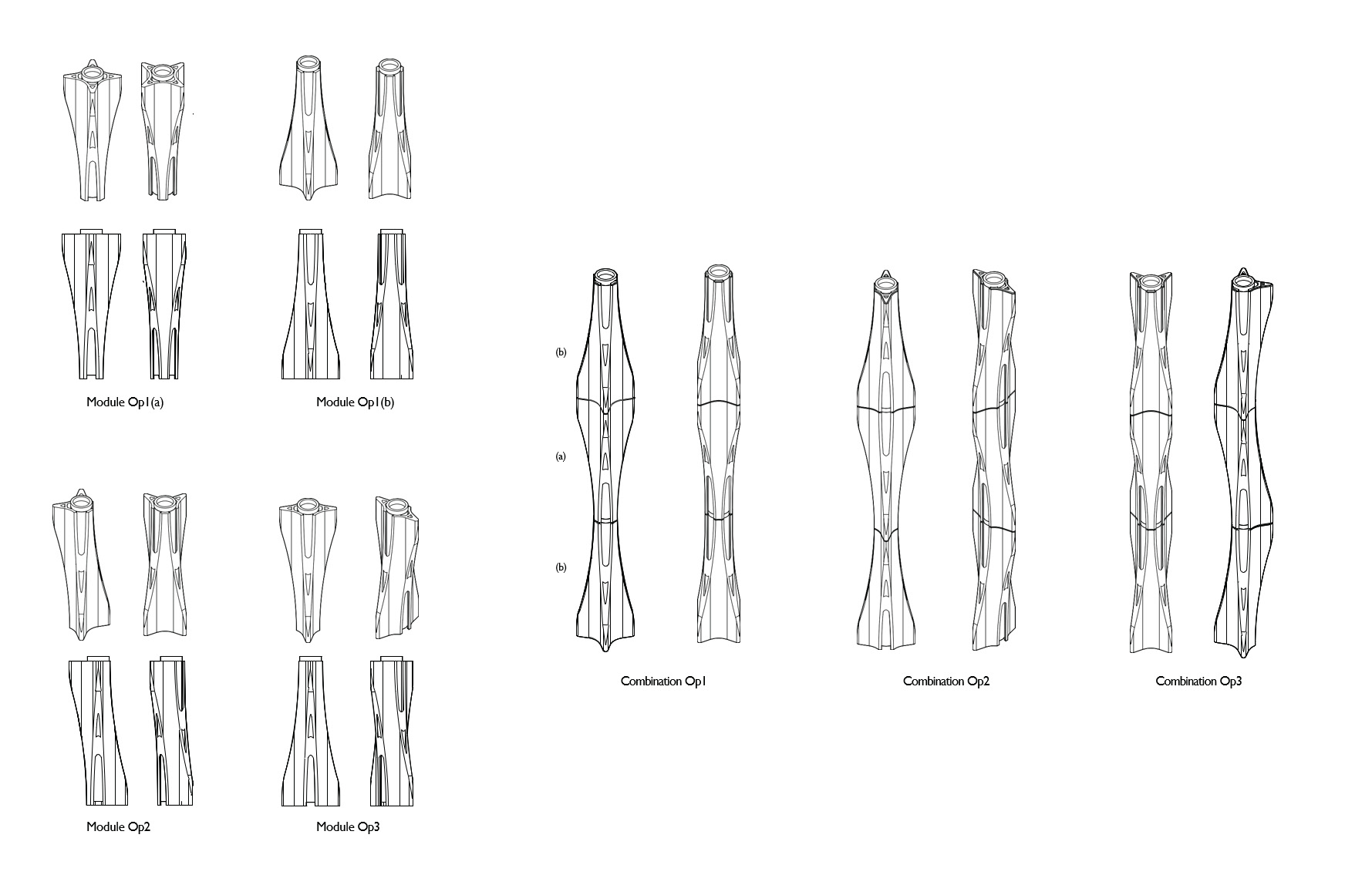
Because the process is parametric, one run yields not a single answer but a family of optimized variants. Each is documented as a perspective/elevation pair, structurally viable and aesthetically distinct, so the design decision becomes a choice among sound options rather than a compromise against structure.
Robotic fabrication and post-tensioned assembly (with Cerámica Cumella)
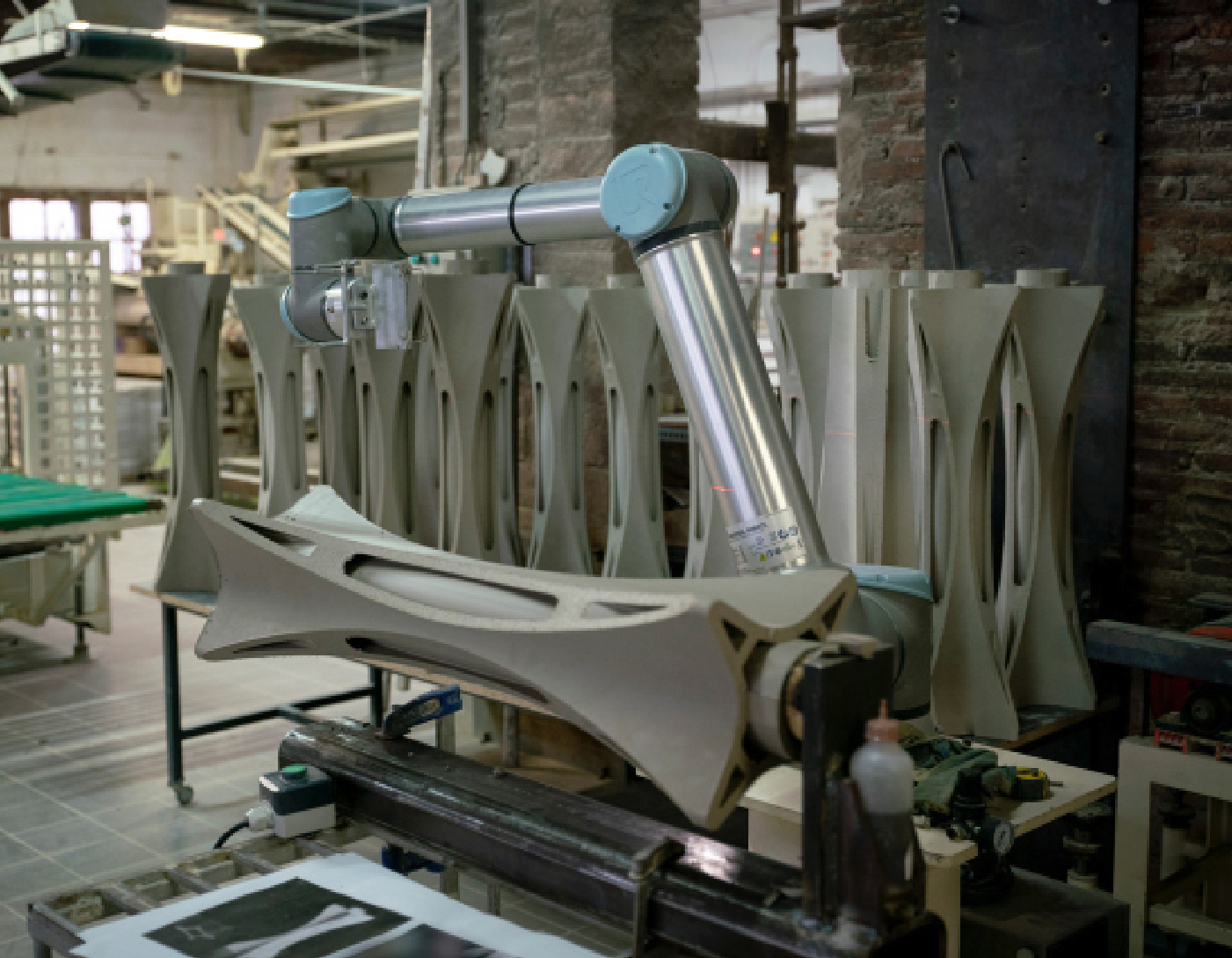
Fabrication was carried out in collaboration with the ceramic manufacturer Cerámica Cumella. The paper is explicit about the two-step manufacturing route: the hollow components are made through conventional extrusion and then finished by robotic subtractive methods — a collaborative robotic arm mills the topology-optimized voids and profile into the extruded blank.
The pipeline runs digital-first: the optimized CAD geometry is converted into a robot toolpath, verified in a simulation of the machining sequence, and only then executed on the physical segment.
optimized column CAD
        │
        ▼
extruded hollow ceramic segment blank
        │
        ▼
robot toolpath  ──►  machining simulation (verify reach / collisions)
        │
        ▼
UR arm — subtractive milling of voids + profile
        │
        ▼
stack segments  ──►  post-tension tendon  ──►  monolithic column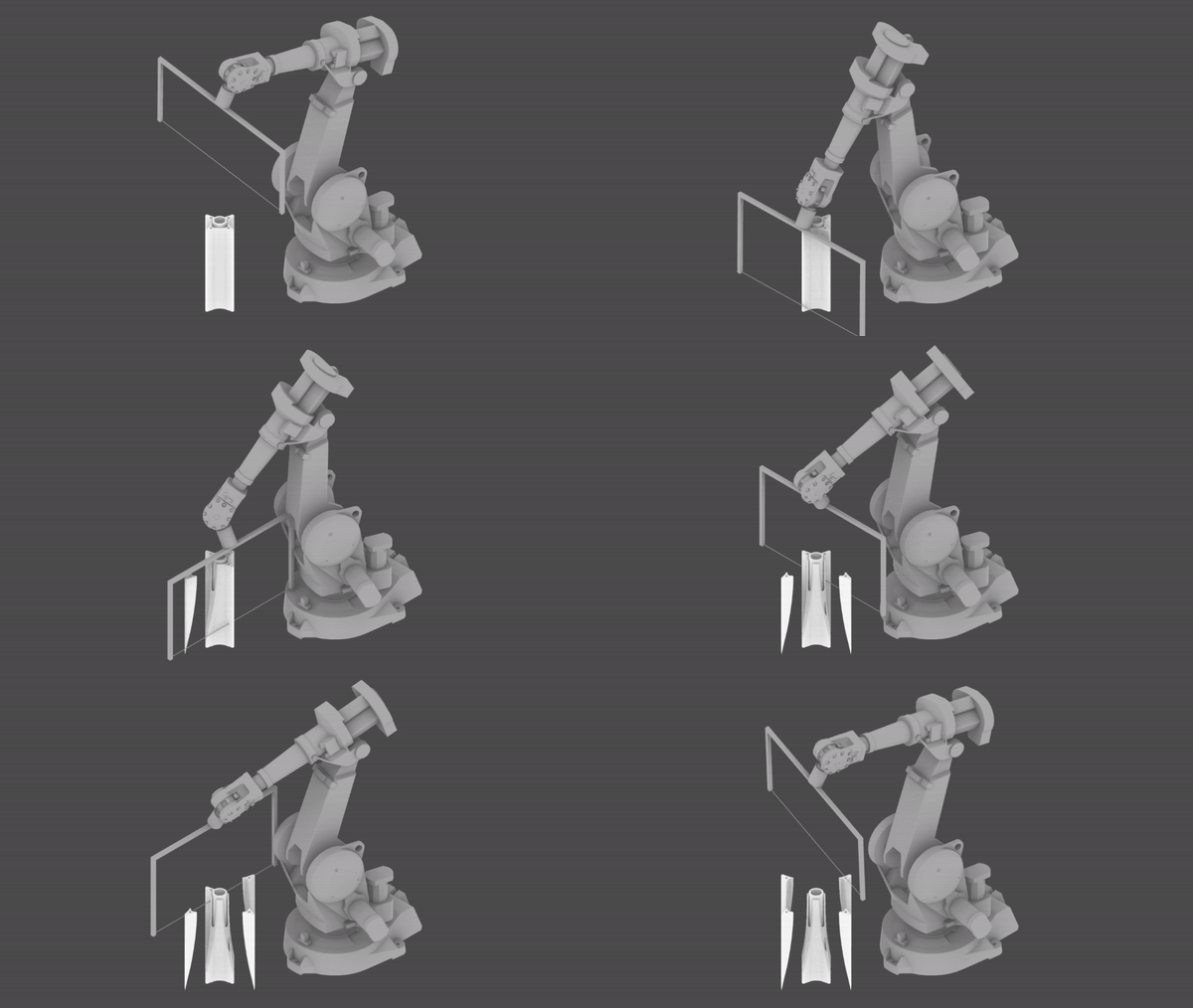
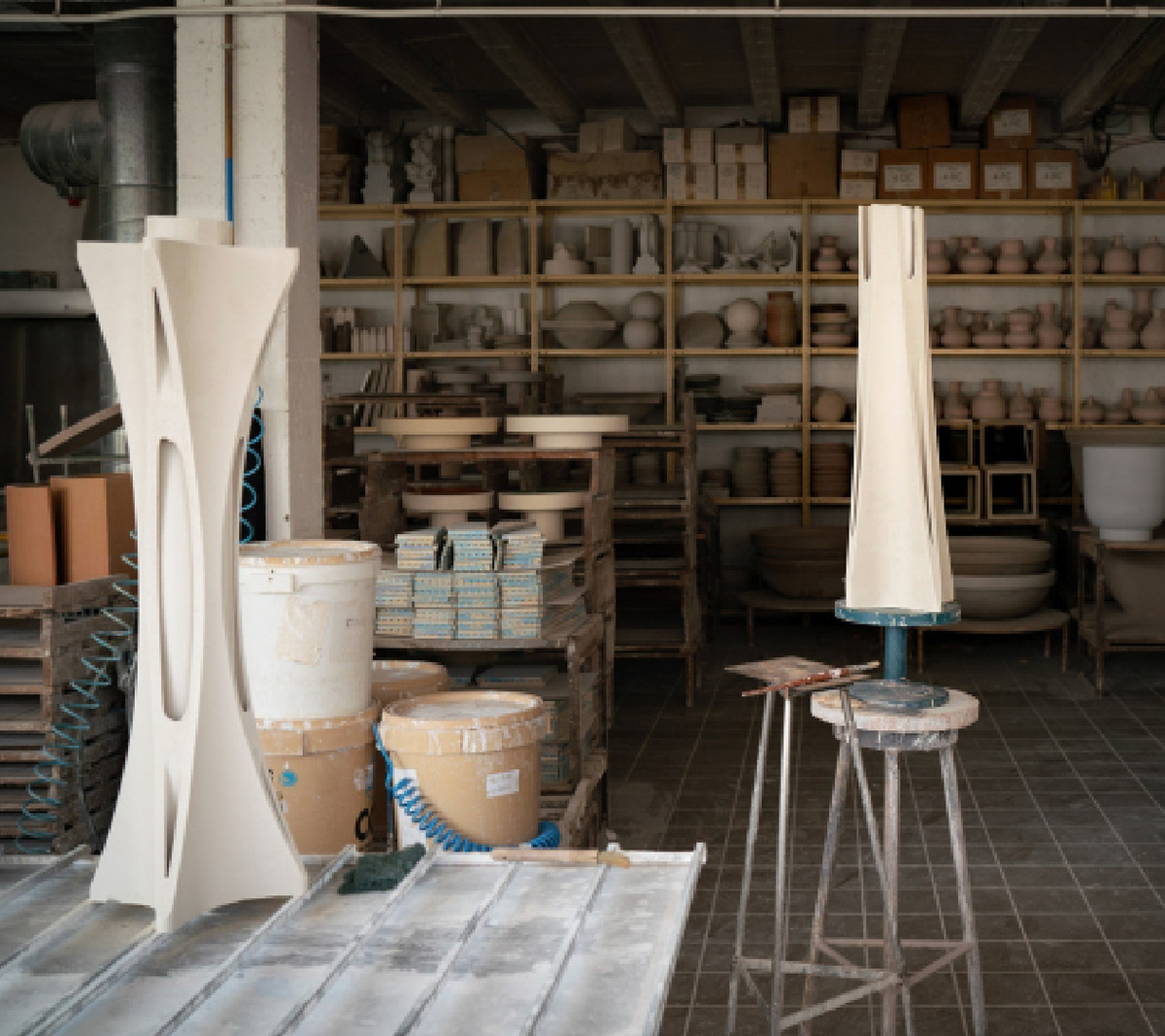
The finished segments stack vertically; a post-tensioning tendon runs through the hollow core and compresses the joints, turning discrete ceramic pieces into a single structural column. The same hollow core is what lets the unit double as a water collector and store.
Fabrication video: youtube.com/watch?v=ATiN7TGZwvQ
Kinematic canopy form-finding
The canopy is a rigid-foldable origami surface that seats onto the column capital. Its motion is developed in Kangaroo for Grasshopper: a dynamic-relaxation solver relaxes the fold under goal constraints so the surface can move between open and closed states while staying geometrically consistent. The motion is tuned against environmental inputs — sunlight and wind — so the canopy can adapt its geometry while maintaining structural stability and aesthetic coherence.
Rather than build the canopy physically, the research delivers it as a digital twin: the simulation captures and visualizes the kinematic stages of the moving adaptive canopy, integrated with the column so that structure and shading read as a single pavilion.
Canopy video: youtube.com/watch?v=ne-7-3s7RPQ
My contribution
- Built the topology-optimization pipeline that generated the column geometry and the parametric catalogue of optimized variants.
- Produced the robotic-toolpath and machining simulation feeding the subtractive fabrication with Cerámica Cumella.
- Developed the Kangaroo dynamic-relaxation form-finding and digital-twin of the kinematic folding canopy.
- Co-author on the IASS 2024 paper (Castellón & Chen).
Outcomes
- Peer-reviewed publication at IASS 2024 (International Association for Shell and Spatial Structures) — the only published research on this portfolio.
- A parametric catalogue of topology-optimized hollow-column variants, structurally derived rather than stylistically drawn.
- A working robotic subtractive-fabrication route — extrusion → toolpath → simulation → machined ceramic segments — validated on physical prototypes at Cerámica Cumella.
- A kinematic canopy digital twin with environmentally-tuned (sunlight/wind) motion.
- A single dual-function component: structural column + water collector with climatic control and water storage.
Links
- IASS 2024 paper — Castellón & Chen, Segmental Ceramic Hollow Structures
- Notion page (full process documentation)
- YouTube — robotic column fabrication
- YouTube — kinematic canopy form-finding
Related cards
- [[2021-2024-Rice—membrane-form-finding]] — parallel Rice parametric studio work
- [[2025-Spring—generative-urbanism]] — Rice architecture studio work