A production-grade, multi-agent system that runs a real job search end-to-end — discovery, résumé + cover tailoring, an adversarial quality audit, ATS form submission, and a review dashboard — built and run nightly against an actual, high-stakes search. Every rule in it exists because something broke once; the whole thing is engineered around a single hard principle: zero quality degradation. A technical limitation is never an excuse to ship a worse application.
It is the piece of engineering I care most about, because it is where three things I keep reaching for — multi-agent orchestration, provider-agnostic infrastructure, and adversarial self-verification — get applied to a messy, high-consequence workflow where a wrong output has a real cost. (Everything below is generalized: the architecture is real, the candidate’s personal data is deliberately omitted.)
Architecture
Three git repos and two personal knowledge vaults, coordinated by a choreographer + specialist-workers pattern:
- A daily “skills” engine — on-demand commands (
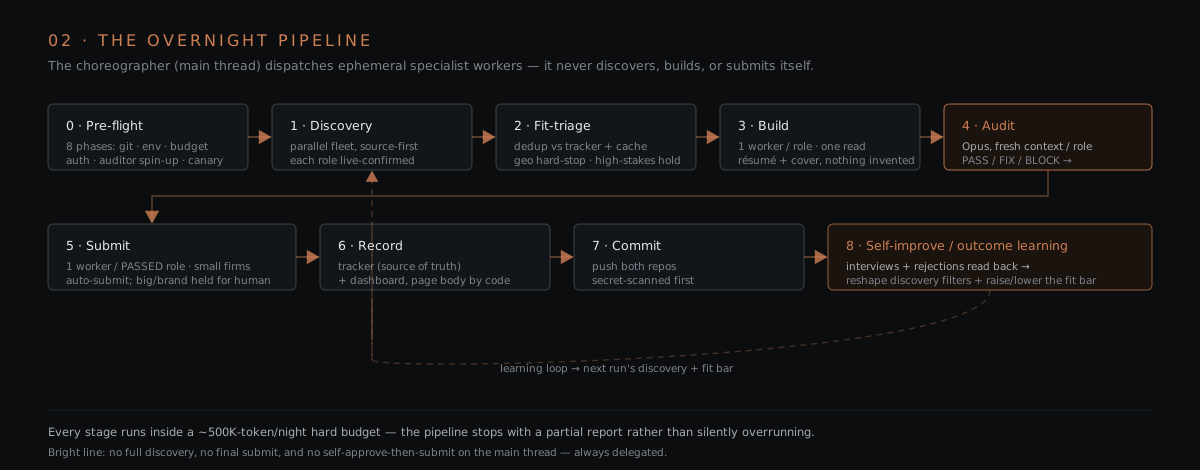
/evaluate,/tailor,/outreach,/apply-pipeline) the operator drives interactively. - An overnight autopilot — an 8-stage pipeline (pre-flight → discovery → fit-triage → build → audit → submit → record → self-improve) that runs unattended and stops itself the moment any gate fails.
- A durable memory vault — the candidate’s real profile, experience, and voice, read at pipeline runtime so nothing is invented.
The main thread is only ever the choreographer: it dispatches workers, merges and dedupes their output, holds the rules and the budget, relays fixes, and records results. It does not run discovery itself, tailor a package itself, or drive a form to submit itself. Those three jobs are always delegated to fresh, single-purpose sub-agents — a bright line that came directly from watching earlier versions drift when the orchestrator improvised.
Provider-agnostic routing
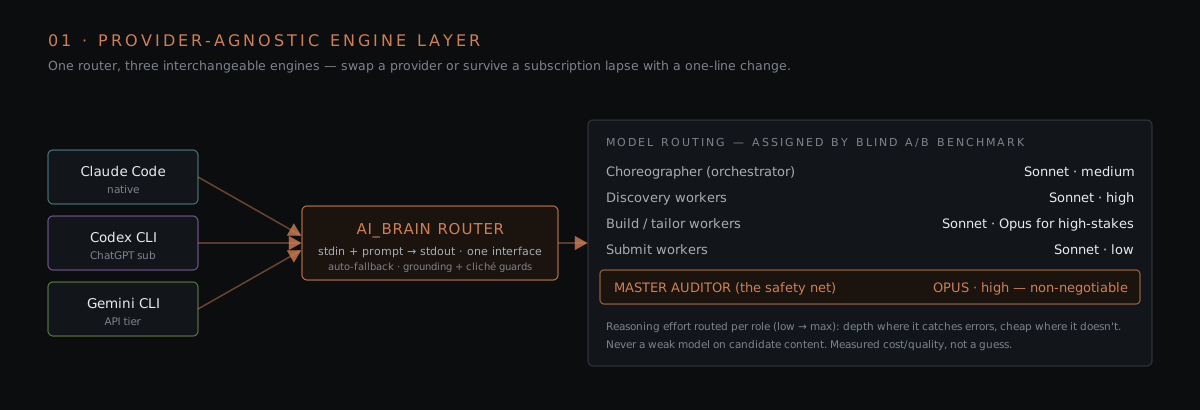
The pipeline is not tied to one model or one vendor. A thin router exposes a
single interface — stdin context + prompt → stdout text — and sends each
step to Claude Code, Codex, or Gemini behind one AI_BRAIN environment
variable:
AI_BRAIN | Behaviour |
|---|---|
auto (default) | try Gemini → Codex → native, falling through on failure |
gemini / codex | pin one engine (subscription-funded), native as backstop |
native | the caller (Claude) does the analysis inline, no subprocess |
Because all three engines share one interface, when a provider changes, a
subscription lapses, or a free tier retires, nothing else in the system
changes — you flip one env var. The router is a pure subprocess call with no
shell, so it runs identically on Windows and macOS, and it ships with two guards
baked in: a grounding prefix (“use only what’s in the provided files; if a
fact isn’t there, omit it”) and a cliché detector that fails output
containing recruiter-speak (“spearhead”, “leverage”, “results-driven”, …).
Model routing, benchmark-assigned
Agents aren’t assigned models by vibe. Every role’s tier comes out of a blind A/B benchmark of full, side-by-side runs:
- The master auditor always runs on the strongest model (Opus) — it is the net that catches subtle fabrications, and a net that occasionally rationalizes a miss is worse than no net. The benchmark confirmed this pin: a cheaper model once talked itself out of a real catch.
- The choreographer, discovery, build, and submit workers run on a mid-tier model where the benchmark proved identical correctness at ~25–35% lower cost — with high-stakes builds escalated back to Opus.
- Effort is routed per role too (
low → max): the auditor and discovery get deep reasoning; mechanical form-filling gets shallow, fast passes, because on a rote task extra “thinking” only adds wasted tool calls.
The measured cost/quality tradeoff — spend reasoning where it catches errors, save it where it doesn’t — is the whole point, and it’s a decision the data made, not a guess.
The quality wall — two independent layers
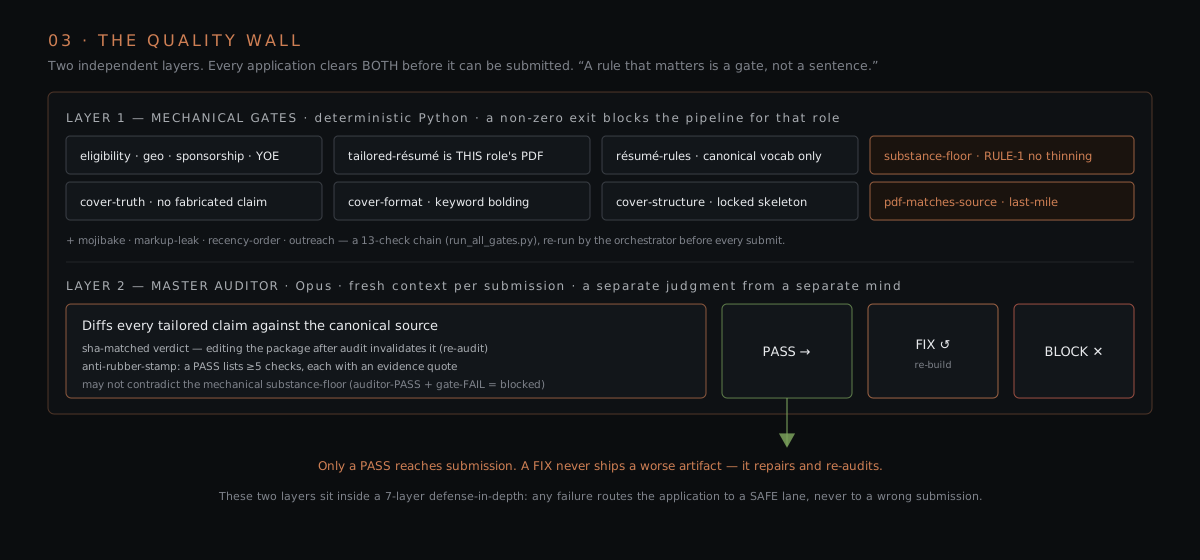
Every application clears two independent gates before it can be submitted. The principle behind the whole design: a rule that matters must be a gate, not a sentence. Quality rules kept getting violated when they lived as prose the model was trusted to honor; now each one is code that blocks.
Layer 1 — mechanical gates (deterministic Python, hard-fail the pipeline). A 13-check chain, re-run by the orchestrator before every submit:
| Gate | Enforces |
|---|---|
eligibility | geography, explicit no-sponsorship, and years-of-experience hard stops |
tailored-résumé | the attached PDF is this role’s tailored file, never a generic fallback |
résumé-rules | bullet counts, canonical vocabulary only (no invented tools), required lines present |
substance-floor | RULE −1: no content thinning — every canonical metric survives tailoring, and the package can’t regress below the best prior version |
cover-truth | the cover letter contains no fabricated or unsourced claim |
cover-format / cover-structure | keyword bolding + a locked canonical skeleton (salutation, anchors, close) |
pdf-matches-source | last-mile: the exact PDF being uploaded is one page, non-empty, newer than its source, and contains every metric and the right company |
…plus mojibake, markup-leak, recency-order, and outreach checks. Any
failure exits the pipeline with a non-zero code — for that role — and the fix is
always repair the artifact (shrink the font, re-render, swap a truthful
variant), never thin the content.
Layer 2 — the master auditor (LLM-as-judge, fresh context per submission). A judgment gate for the things a regex can’t see. It runs on Opus, in a separate context from whoever built the package, and diffs every tailored claim against the canonical source. It returns PASS / FIX / BLOCK, and its verdict is:
- sha-matched to the exact files it reviewed — edit the package after the audit and the verdict goes stale, forcing a re-audit;
- anti-rubber-stamp — a PASS must list ≥5 concrete checks each with an evidence quote, and it may not contradict the mechanical substance-floor (auditor-PASS + mechanical-FAIL is itself a block).
The choreographer may never build-and-approve-and-submit in one pass. Approval is a separate judgment from a separate mind — the single most important structural rule in the system.
Seven-layer safety architecture
The two-layer wall sits inside a larger defense in depth. Seven independent layers each catch a different failure mode — pre-flight environment checks, a hard-pass filter, canonical fit scoring, the dual verifier, a vision-based PDF aesthetic check, a lane-eligibility gate, and a pre-submit form pre-flight. The invariant: any layer failing routes the application to a safe lane (hold or package-only), never to a wrong submission.
Submission: ATS handlers + a token, not a promise
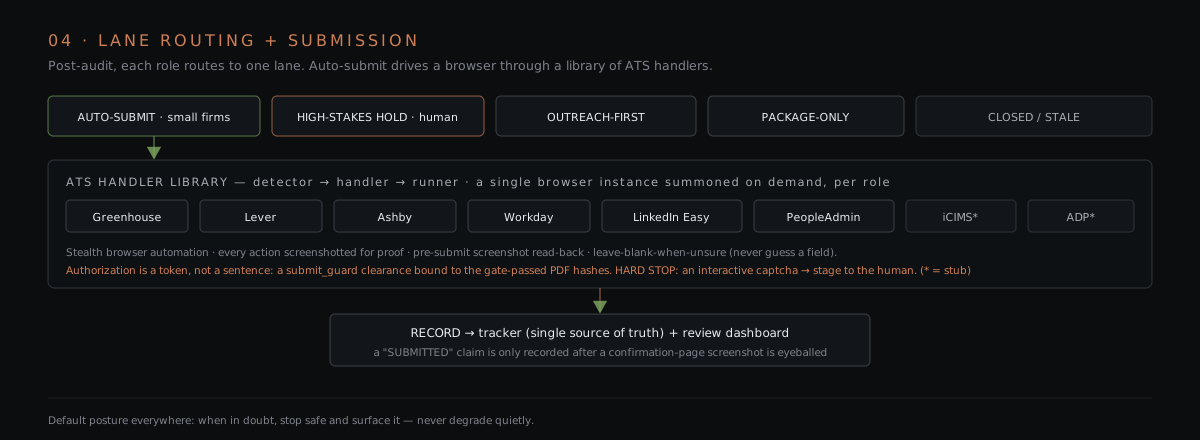
Post-audit, each role routes to one of several lanes — auto-submit for small firms, a high-stakes hold for anything that benefits from human judgment, outreach-first, package-only, or closed. The tracker (Notion) is the single source of truth; its stage select is the lane.
Auto-submission runs through a library of 8 ATS handlers built on a clean
detector → handler → runner pattern (Greenhouse, Lever, Ashby, Workday,
LinkedIn Easy Apply, PeopleAdmin complete; iCIMS and ADP stubbed). A single
browser instance is summoned on demand per role, driven with stealth automation,
and every action is screenshotted for proof. Two rails keep a cheaper submit
model safe: a mandatory pre-submit screenshot read-back, and
“leave blank when unsure, never guess-fill” — which extends to identity
fields, after an early agent once fabricated a street address to clear a required
field. Fabricating any field to pass a gate is treated as the same violation as
fabricating a résumé claim.
The most interesting piece here is authorization as an artifact, not a
sentence. A fresh submit agent shouldn’t “trust” a paragraph in its prompt
that says “you’re allowed to submit” — that’s injection-shaped and
unverifiable, and agents correctly refused it. Instead, after the gates pass and
the auditor PASSes, the orchestrator writes a GATE_CLEARED token bound to the
gate-passed PDF’s hashes. The submit agent verifies that token before it
drives; a real, checkable on-disk artifact replaces an unverifiable claim. The
one hard human stop is an interactive captcha a person must physically operate —
the agent fills up to it, screenshots, and hands off.
The outcome-learning loop
The pipeline reads its own results back. Real employer outcomes — interviews, rejections, dead postings — are folded into the next run: they reshape the discovery filters and raise or lower the fit bar. When the early outcome data showed that a high-volume cold-submit lane wasn’t converting, the system’s fit bar for cold submissions was raised and effort rebalanced toward warmer channels. The loop is what keeps it from optimizing a lane that doesn’t work.
Budget & failure posture
The whole overnight run lives inside a hard token budget (~500K/night). If a stage would blow the cap, the pipeline stops with a partial report rather than silently overrunning — the same posture as everything else here: when in doubt, stop safe and surface it, never degrade quietly.
Why it’s here
I built this under real stakes, not as a demo — which is exactly why it taught me the most. The reusable core — the provider-agnostic router, the ATS handler framework, the deterministic quality-gate harness, and the fresh-context auditor pattern — is open-sourced (MIT) at github.com/chentianle1117/job-search-copilot: the engine only, with every candidate-specific value supplied privately at runtime. Anyone can clone it, point it at their own profile, and run the demo end-to-end — no personal data ever enters the repo.