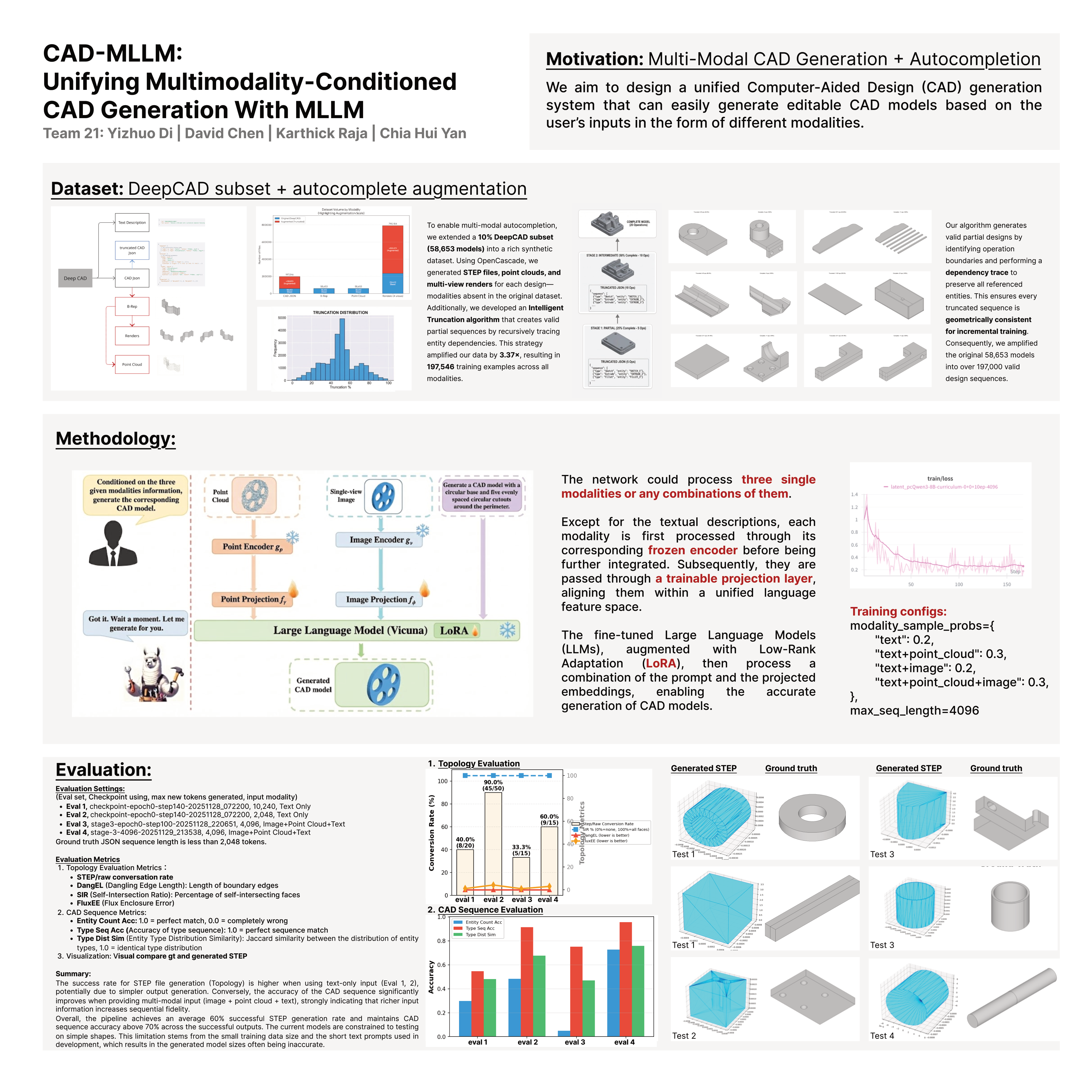
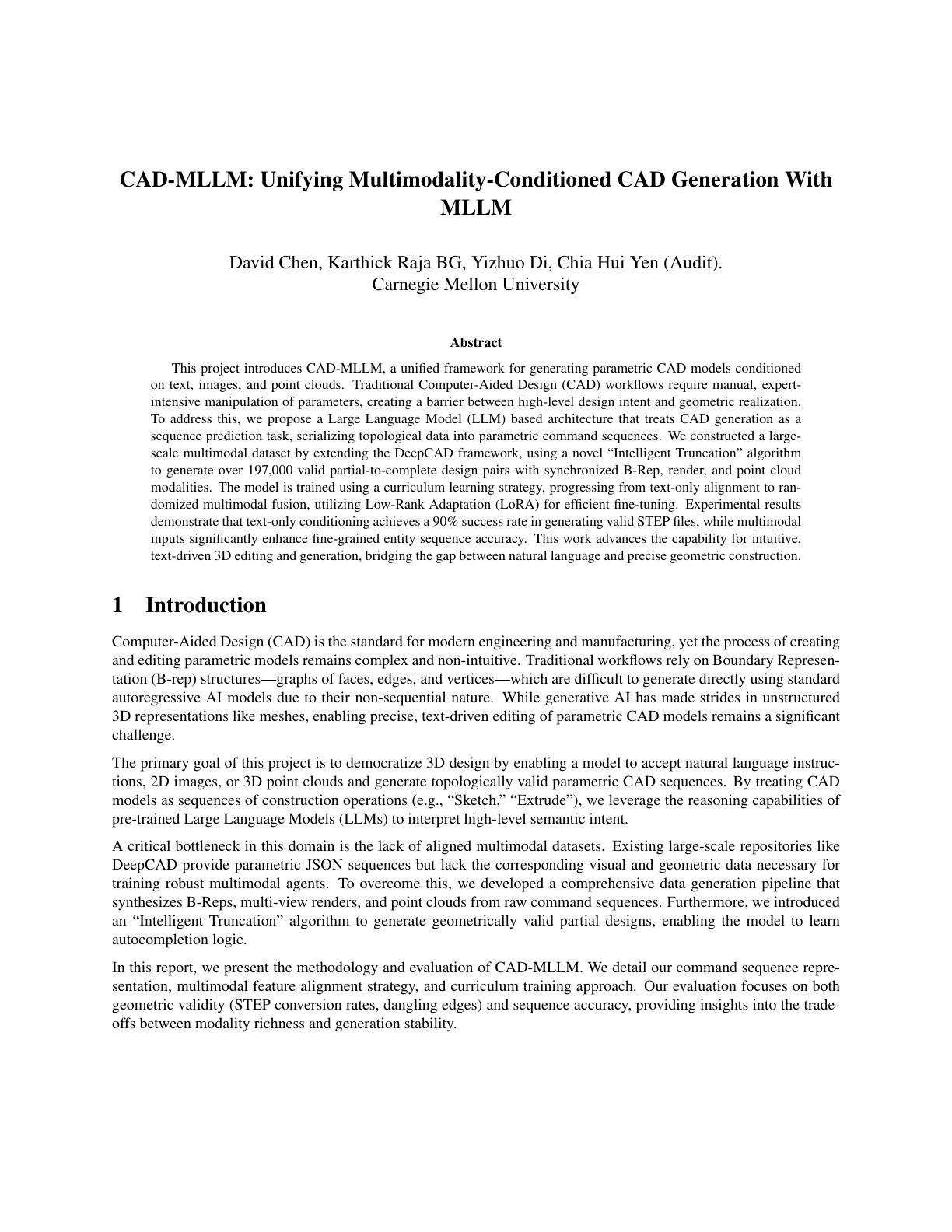
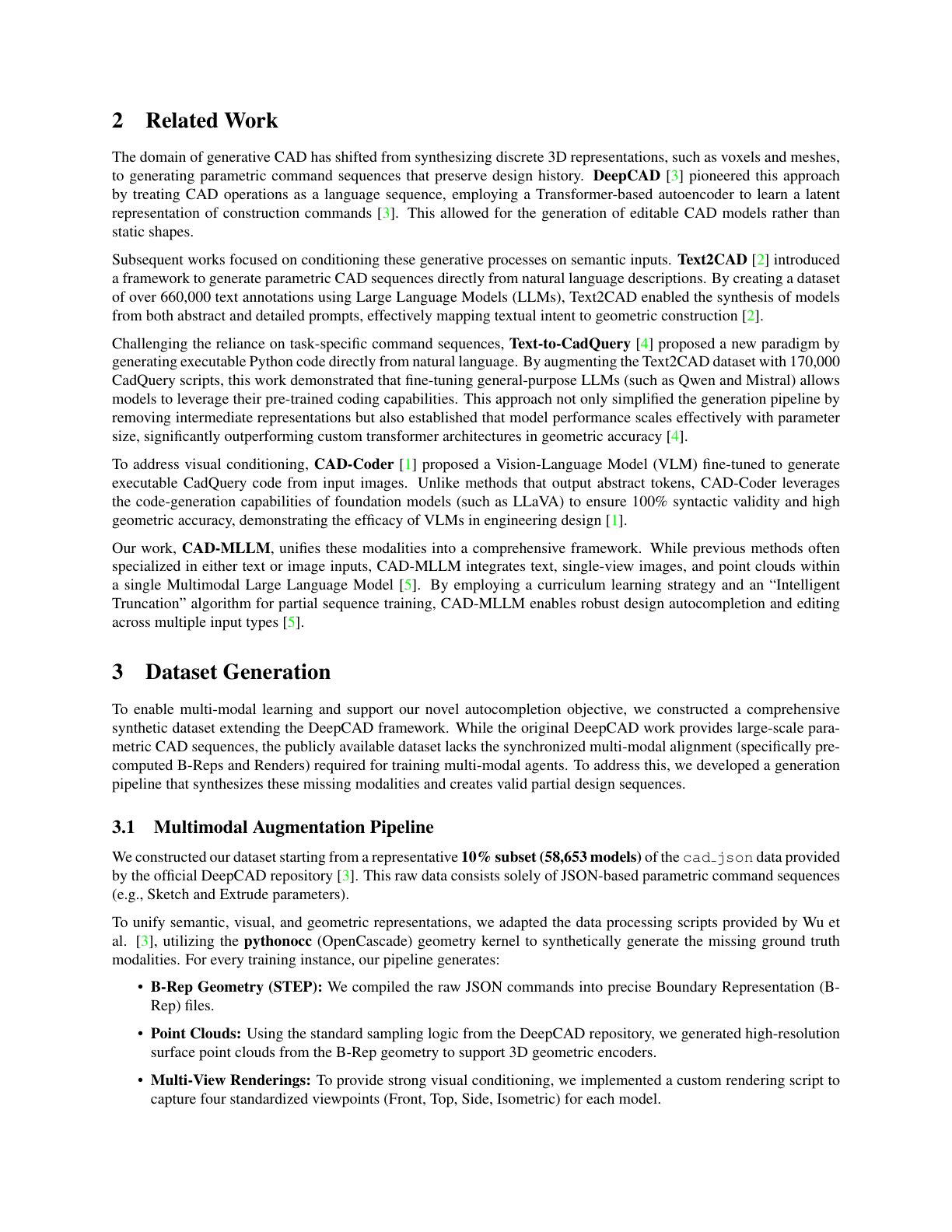
Team 21’s unofficial reproduction and extension of CAD-MLLM (arXiv:2411.04954) for CMU 16-825, Learning for 3D Vision (Fall 2025). One large language model accepts text, a rendered image, a point cloud, or any non-empty combination and generates an editable parametric CAD command sequence that compiles to a real B-Rep solid. My contribution was the autocompletion extension — training the model to complete partial designs, built on the
autocomplete/autocomplete_2branches.
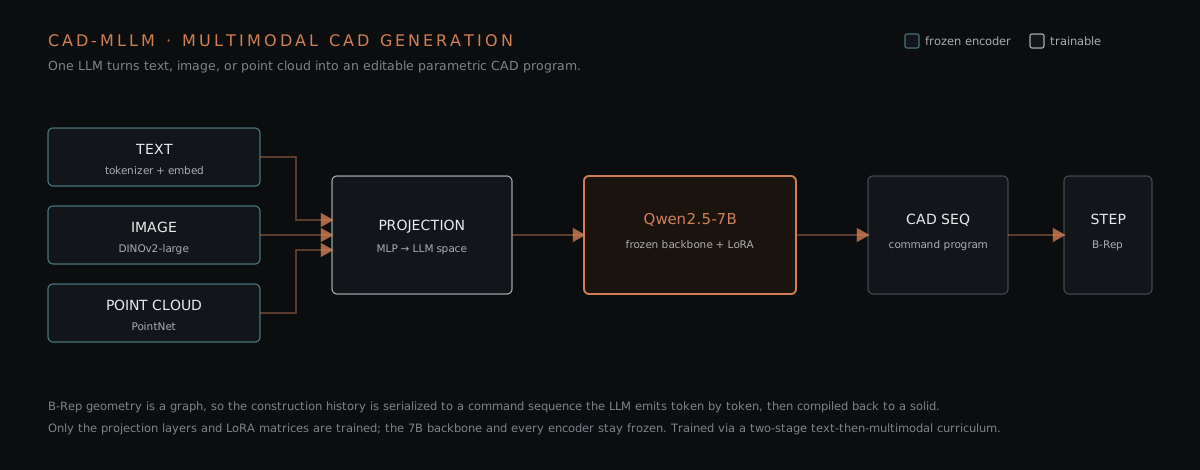
The problem is narrow and real. Parametric CAD is authored as a history of construction operations (sketch a profile, extrude it, fillet an edge), but it is stored as a Boundary Representation (B-Rep) — a graph of faces, edges, and vertices. A graph is not a sequence, so autoregressive models can’t emit it directly, and there is a genuine gap between high-level design intent (“a bracket with two mounting holes”) and the precise parametric operations that realize it. CAD-MLLM closes that gap by treating CAD generation as sequence prediction: serialize the construction history into a command sequence an LLM can generate token by token, then compile the sequence back into geometry.
What was actually built
Three pieces, in dependency order:
- A synthetic multimodal dataset built on a 10% DeepCAD subset (58,653 models), because DeepCAD ships only JSON command sequences — no aligned images, point clouds, or partial-sequence pairs. The team synthesized all of them with the OpenCascade geometry kernel.
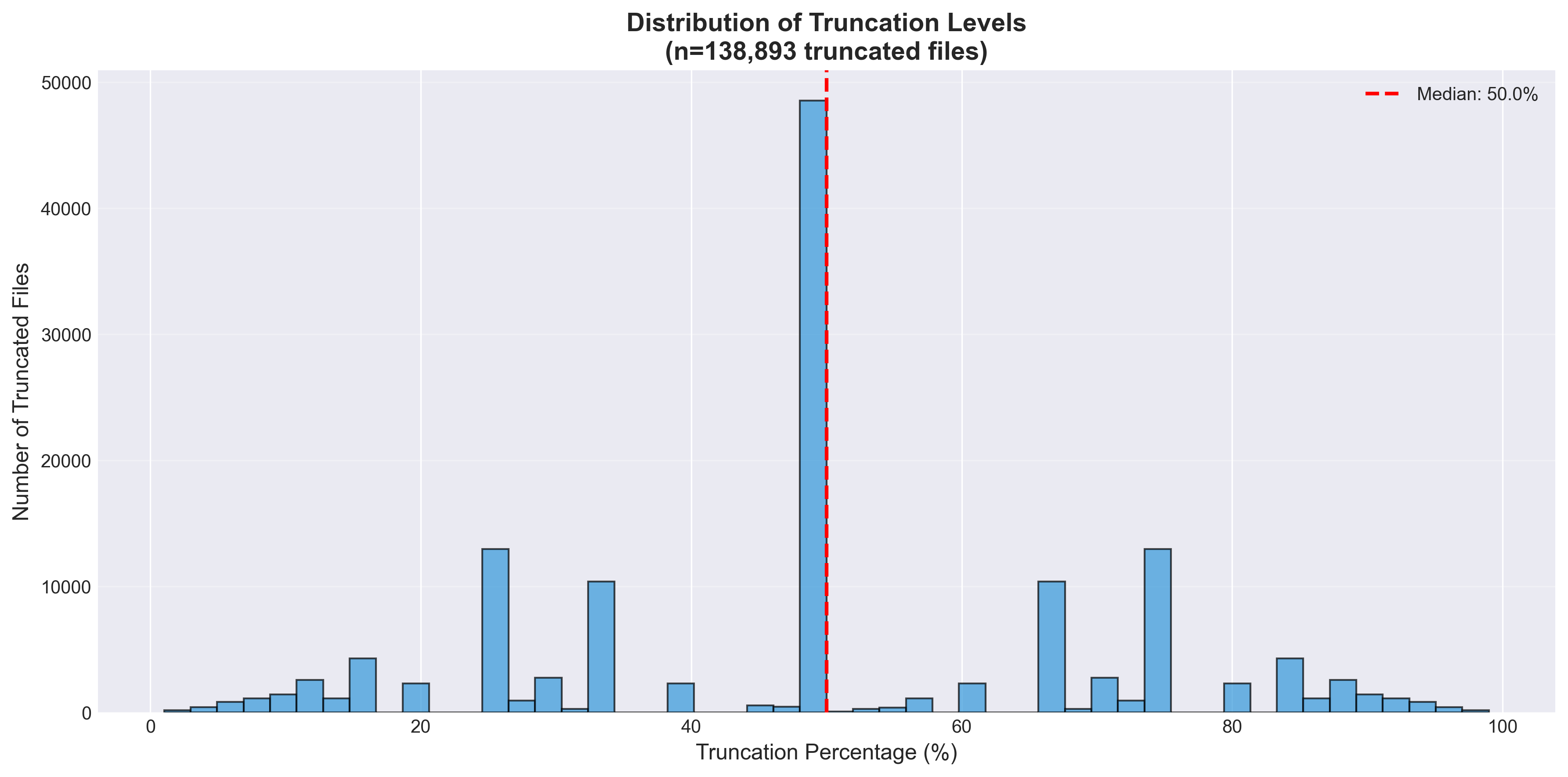
- An “Intelligent Truncation” algorithm that derives geometrically valid partial CAD sequences from complete ones, amplifying the training set and enabling design autocompletion — a capability the original paper does not have.
- A multimodal LLM — Qwen2.5-7B with LoRA plus frozen per-modality encoders and trainable projection layers — trained with a two-stage curriculum and evaluated on both geometric validity and sequence accuracy.
CAD as a command sequence
A CAD model M is represented as a sequence of construction operations S = {c1, c2, …, cN}, where each ci is a command type ti (e.g. Sketch, ExtrudeFeature, Line, Arc, Circle) plus its geometric parameters pi (coordinates, radius, extrusion depth). Concretely the dataset carries a JSON with an entities dict and a sequence list:
{
  "entities": {
    "sketch_id_0":  { "type": "Sketch", "profiles": { ... }, "reference_plane": { ... } },
    "feature_id_0": { "type": "ExtrudeFeature", "profiles": [ ... ], "extent": { ... } }
  },
  "sequence": [
    {"index": 0, "type": "Sketch",         "entity": "sketch_id_0"},
    {"index": 1, "type": "ExtrudeFeature", "entity": "feature_id_0"}
  ]
}
The model is trained with a standard causal-LM objective — maximize the log-likelihood of the next command token given the conditioning inputs C ⊆ {T, I, P} and the preceding tokens.
Dataset — synthesizing the missing modalities
For every one of the 58,653 source models, the pipeline (pipeline/process_cad.py, pipeline/render_cad.py) generates, via pythonocc / OpenCascade:
- B-Rep geometry (STEP) — the raw JSON commands compiled into a precise boundary representation.
- Point clouds — surface-sampled points using DeepCAD’s sampling logic, feeding the 3D encoder.
- Multi-view renderings — four standardized viewpoints (Front, Top, Side, Isometric) per model. Across the dataset this comes to 790,184 renderings.
The result is a unified corpus where each design exists in textual (command sequence), visual (renders), and geometric (B-Rep / point cloud) form.
Intelligent Truncation — the core data contribution
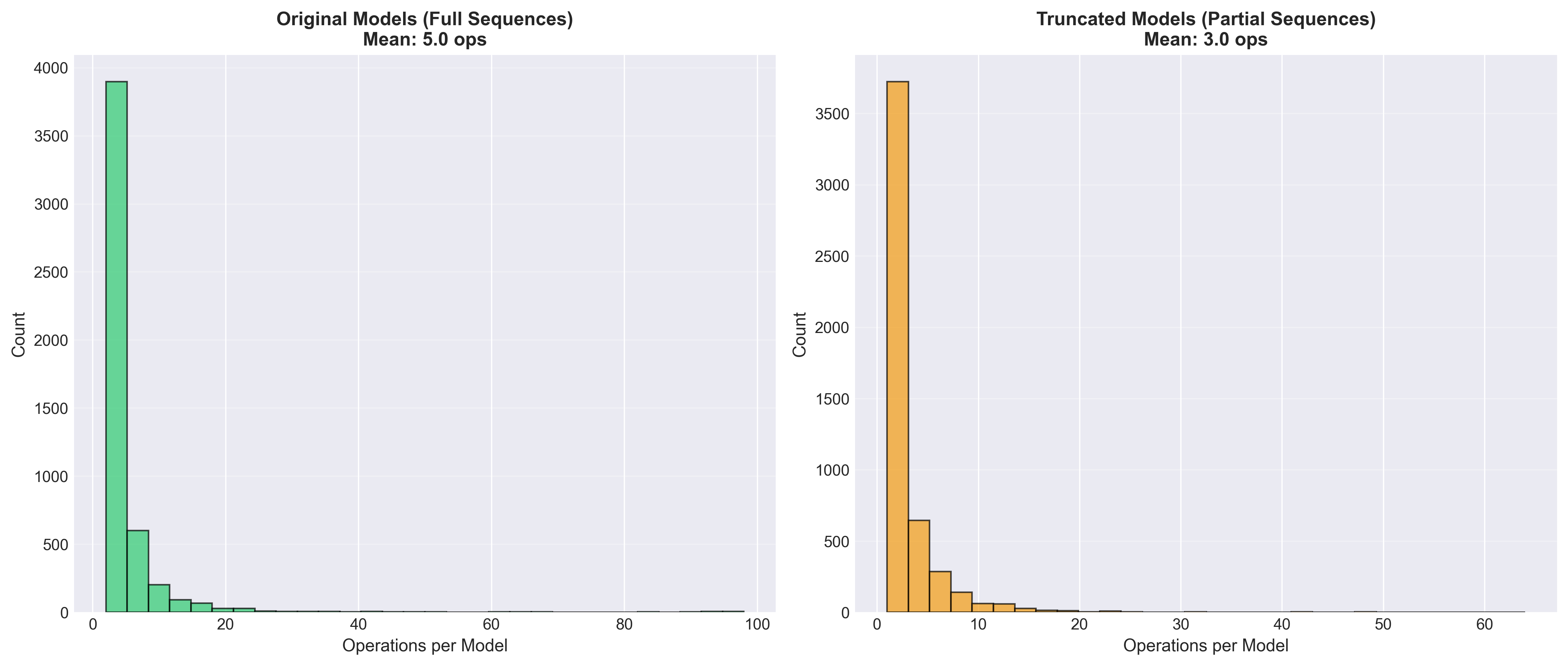
To train autocompletion you need (partial input → complete target) pairs. Naively cutting a parametric sequence at a random index usually breaks it — you get a sketch with no reference plane, or a fillet referencing an edge that doesn’t exist yet. The Intelligent Truncation algorithm enforces geometric validity at every cut:
- Operation-boundary detection — only cut at valid stopping points (e.g. immediately after an
ExtrudeFeaturecompletes), never mid-feature. - Dependency tracing — for a chosen cut, recursively walk the entity dependency graph (
ExtrudeFeature → profiles → Sketch → reference plane) and keep everything the partial sequence needs. - Entity cleanup — prune “orphan” entities that are defined but no longer referenced, and attach truncation metadata (
original_operations,kept_operations,truncation_percentage).
def truncate_json(self, data, truncate_at_idx):
    truncated["sequence"] = data["sequence"][: truncate_at_idx + 1]
    referenced = self.get_referenced_entities(truncated["sequence"], data["entities"])
    truncated["entities"] = {eid: e for eid, e in data["entities"].items() if eid in referenced}
    kept, total = len(truncated["sequence"]), len(data["sequence"])
    truncated["truncation_metadata"] = {
        "is_truncated": True, "original_operations": total,
        "kept_operations": kept, "truncation_percentage": kept / total * 100,
    }
    return truncated
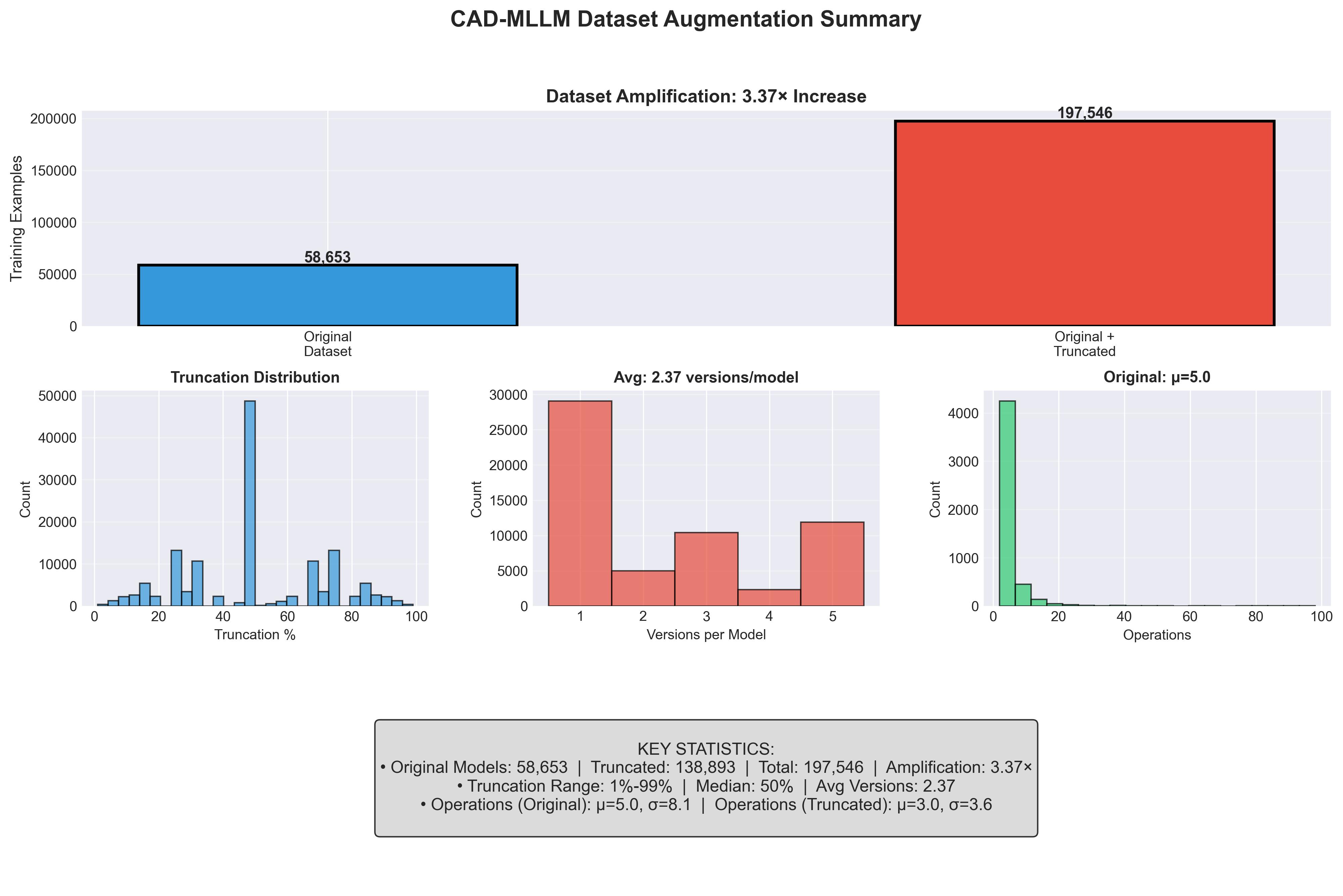
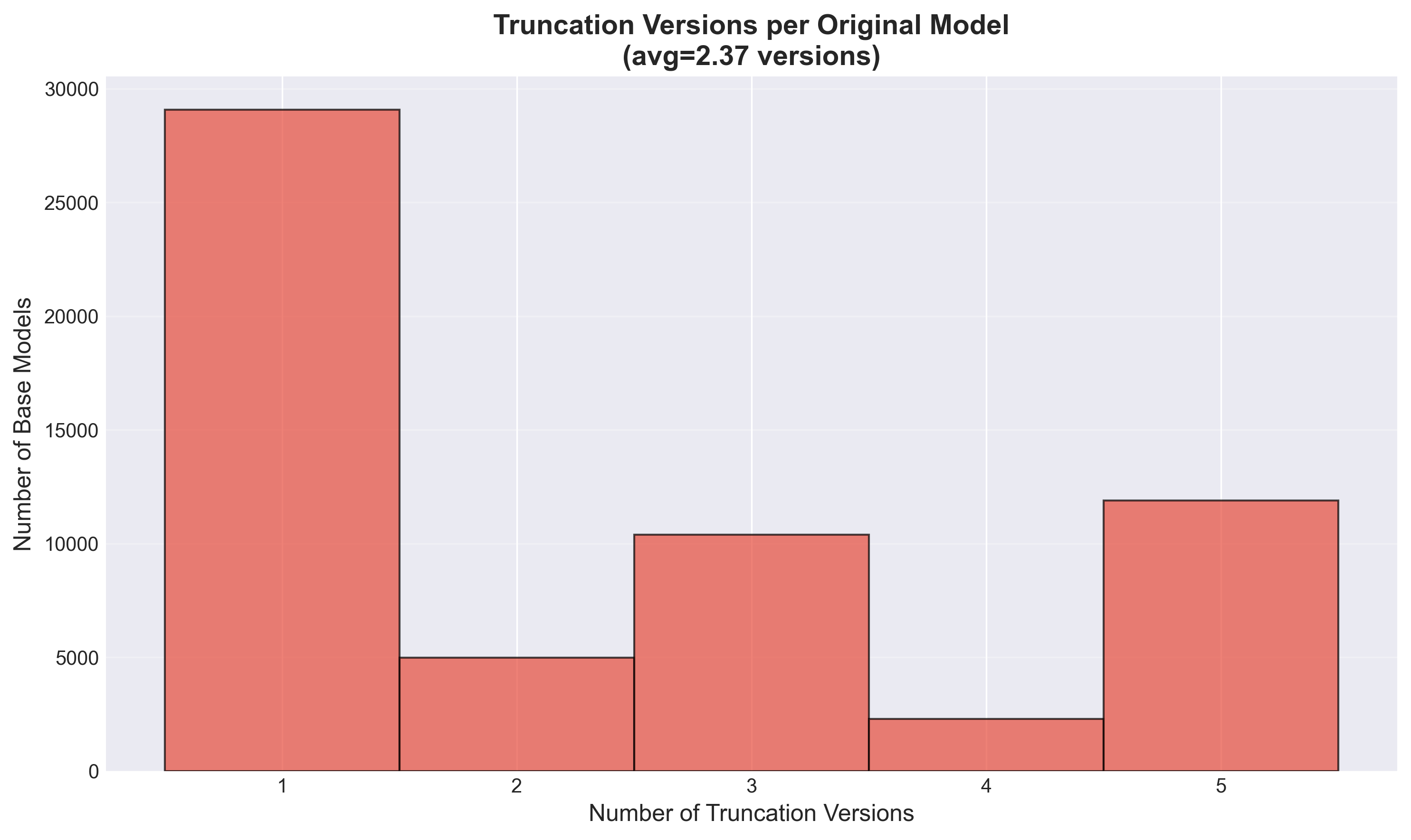
Each source model yields up to five evenly-spaced partial variants (roughly 25% / 50% / 75% completeness, never 100%). This produces multiple valid partial states from one model and teaches the model the logic of incremental construction.
Amplification numbers (from the final report, Table 1)
| Metric | DeepCAD source | Ours | Gain |
|---|---|---|---|
| Distinct models | 58,653 | 58,653 | 1.0× |
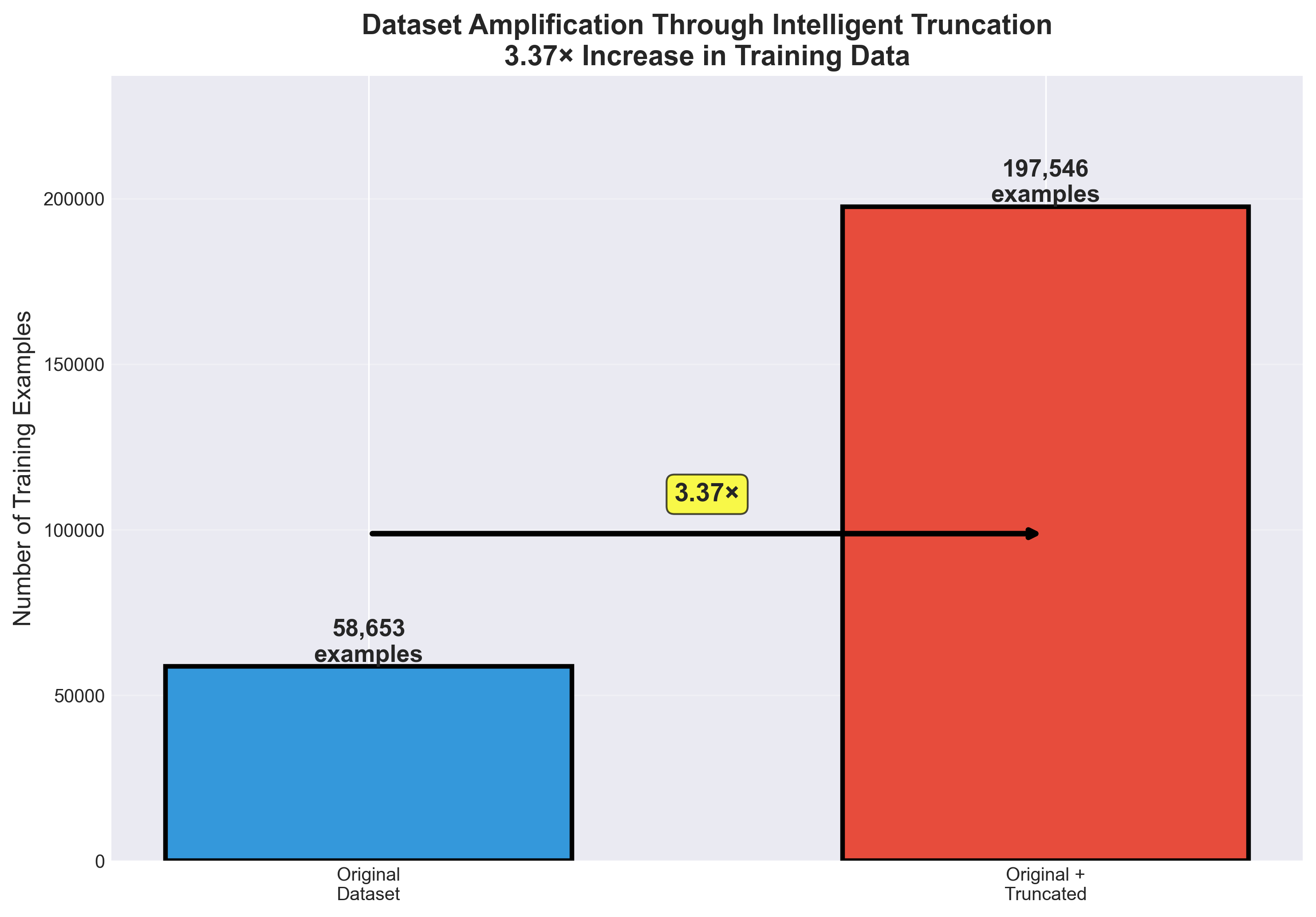
| Training sequences | 58,653 | 197,546 | 3.37× |
| B-Rep (STEP) | — | 58,653 | new |
| Point clouds | — | 58,653 | new |
| Renderings | — | 790,184 | new |
| Avg. versions / model | 1.0 | 2.37 | 2.37× |
| Completeness coverage | 100% only | 1%–99% | — |
The two multipliers describe the same result from different angles: truncation adds an average of 2.37 partial versions per model, so the total sequence count grows to 3.37× the source (1.0 original + 2.37 truncated). Reported processing was fast — the full-subset truncation pass runs in roughly 10–20 minutes.
Model architecture
The core is a pre-trained LLM backbone with separate frozen modality encoders aligned into its embedding space (cad_mllm/model.py).
| Component | Choice | Trainable? |
|---|---|---|
| LLM backbone | Qwen2.5-7B (AutoModelForCausalLM) | frozen weights + LoRA |
| Adaptation | LoRA on q/k/v/o/gate/up/down_proj | ✅ |
| Text | native tokenizer + LLM embedding layer (identity projector) | — |
| Image encoder | DINOv2-large (facebook/dinov2-large); patch tokens, CLS dropped; multi-view supported | frozen |
| Point-cloud encoder | PointNet-style Conv1d stack + global max-pool → one global token (2048 points) | frozen |
| Projection layers | 2-layer MLP (hidden 2048) mapping each encoder’s output into LLM dim D | ✅ |
| Fusion | concatenation of [E_text · E_image · E_point] along the sequence dimension | — |
DINOv2 is used deliberately over CLIP — its self-supervised features carry stronger geometric and structural signal, which matters for CAD. Only the projection layers and LoRA matrices are optimized; the LLM backbone and all encoders stay frozen, which is what makes fine-tuning a 7B model feasible on a single GPU.
Training
Everything ran in PyTorch + HuggingFace Transformers on a single NVIDIA A100 (80 GB) on Google Colab.
LoRA + optimization (final report §5):
- LoRA rank r = 16, α = 32, dropout = 0.05
- AdamW (β1 = 0.9, β2 = 0.95), weight decay
- Cosine-annealing LR, 3% warmup, peak LR 2 × 10⁻⁴
- Global batch size 16 via gradient accumulation
- max sequence length 4096
Two-stage curriculum:
- Stage I — text-only alignment. Train exclusively on Text-to-CAD pairs so the model learns the valid command-sequence syntax and a strong NL → CAD mapping before any other modality is introduced.
- Stage II — randomized multimodal fusion. Introduce image and point-cloud modalities, and for each sample condition on a random non-empty subset
C ⊆ {T, I, P}. This forces robustness to whatever combination is available at inference — text alone, image alone, or all three together.
Evaluation
The eval pipeline runs seven steps per sample: text prompt → JSON inference → JSON→STEP export → 3D visualization → topology check → JSON structure validation → sequence-metric scoring. Samples are filtered to ground-truth sequences under 2048 tokens; sampling temperature 0.5.
Topology metrics: STEP/raw conversion rate (% of outputs that compile to a valid STEP), Dangling-Edge Length (DangEL, unclosed boundary), Self-Intersection Ratio (SIR), Flux Enclosure Error (FluxEE). Sequence metrics: Entity Count Accuracy, Type-Sequence Accuracy (edit-distance based), Type-Distribution Similarity (Jaccard).
Four configurations were run (final report Tables 2–4):
| Eval | Input | Max tokens | STEP conversion | Entity Acc | Type-Seq Acc | Type-Dist Sim |
|---|---|---|---|---|---|---|
| 1 | Text only | 10,240 | 40.0% (8/20) | 0.299 | 0.547 | 0.480 |
| 2 | Text only | 2,048 | 90.0% (45/50) | 0.482 | 0.915 | 0.676 |
| 3 | PC + Image + Text | 4,096 | 33.3% (5/15) | 0.050 | 0.750 | 0.469 |
| 4 | PC + Image + Text | 4,096 | 60.0% (9/15) | 0.727 | 0.955 | 0.758 |
Two findings hold up across the runs:
- Text-only conditioning maximizes geometric validity (up to 90% STEP conversion) because it produces simpler, more syntactically conservative outputs.
- Multimodal conditioning maximizes sequence fidelity — the best multimodal run (Eval 4) reaches the highest entity-count, type-sequence, and type-distribution accuracy — but at a lower conversion rate, because richer inputs push the model toward more detailed and therefore more fragile geometry.
Token budget matters too: a very large budget (10,240) lets the model produce longer, more detailed sequences but also more inconsistent ones (Eval 1’s 40% conversion), while a tighter budget (2,048) is more stable at the cost of fine detail. This is the central trade-off documented in the report: expressiveness vs. reliability. The honest limitation stated in the report and poster: the current pipeline reliably handles simple shapes only, constrained by the modest training-data size and short text prompts.
My contribution — the autocompletion extension
My work lives on the autocomplete and autocomplete_2 branches and targets the partial-to-complete task that Intelligent Truncation makes possible:
- Truncated-text masking during training — the training loop masks the completed portion of a partial sequence so the loss is computed only over the tokens the model must predict, teaching it to continue a design rather than regenerate it (
scripts/train_curriculum.py, commit “Update: truncated_text masking”). - Autocomplete inference + evaluation pipeline — dedicated
scripts/inference_autocomplete.pyandscripts/evaluate_autocomplete.py, plus fixes to make generation work correctly under PEFT/LoRA (overriding the defaultmax_length=20, switching tomax_new_tokens, and working around a PEFTinputs_embedslimitation for text-only mode). - Hyperparameter sweeps — an overnight sweep harness (
scripts/run_overnight_sweep.sh,sweep_overnight_5070ti.yaml) run locally on an RTX 5070 Ti, with W&B logging and checkpoint cleanup utilities. - Published weights — the resulting fine-tuned model is on HuggingFace as
chentianle1117/autocomplete-stage3-8000.
Results and outcomes
- A working unofficial reproduction of a multimodal CAD-generation paper — end to end, from raw DeepCAD JSON to a compiled STEP solid.
- A genuinely novel data contribution (Intelligent Truncation) that both amplifies the dataset 3.37× and unlocks autocompletion, which the original paper does not do.
- A rebuilt DeepCAD subset carrying the modalities it originally lacked: 58,653 STEP solids, 58,653 point clouds, and 790,184 multi-view renders.
- Quantified the modality trade-off (validity vs. fidelity) with four controlled eval configurations and four topology + three sequence metrics.
- Published model weights and dataset; team poster presented at the L43D poster session (December 2025); full final report delivered.
Team and role
Flat team, no group leader. Active members: David Chen, Karthick Raja BG, Yizhuo Di; Chia Hui Yen participated as an audit. The canonical repo lives on Yizhuo’s GitHub (veoery); a personal fork preserves the project under my name. My scope was the autocompletion extension and its training/eval tooling.
Links
Code
- Personal fork: chentianle1117/CAD-MLLM-unofficial — primary portfolio link
- Upstream team repo: veoery/CMU16825_Final_project
- Branches:
autocomplete·autocomplete_2
Models + data
- HuggingFace org:
omnicad-lab-L3d - My model:
chentianle1117/autocomplete-stage3-8000 - Dataset:
omnicad-multimodal-subset-fast
Docs
- Final report (PDF) · Poster (PDF) · Project proposal (Google Doc)
- CAD-MLLM reference paper (arXiv:2411.04954)
References cited in the report
- DeepCAD (Wu et al., ICCV 2021) — source dataset and processing kernel
- Text2CAD (NeurIPS 2024) · Text-to-CadQuery (arXiv:2505.06507) · CAD-Coder (ASME 2025) — related conditioning approaches